" height="90.30000045776367px" id="Tu119EZZY" transform="translate(105 0)" width="720.150009765625px"/><path d="M 29.62 59.253 C 13.299 59.253 0 46.072 0 29.626 C 0 13.302 13.298 0 29.62 0 Z M 88.859 59.374 C 88.859 75.698 75.681 89 59.24 89 C 42.918 89 29.62 75.698 29.619 59.374 Z" fill="rgb(0, 0, 0)" height="89.00000054931641px" id="sqCofdzoM" transform="translate(0 1)" width="88.85899948120118px"/><path d="M 29.62 59.011 L 0 59.011 C 0 75.335 13.299 88.637 29.62 88.637 Z M 59.24 58.527 C 75.319 58.526 88.495 45.347 88.495 29.263 C 88.495 13.18 75.318 0 59.239 0 C 43.16 0 29.982 13.18 29.982 29.263 C 29.982 45.346 43.159 58.526 59.239 58.527 Z" fill="rgb(0, 0, 0)" height="88.63700158691407px" id="KVHbMuD7K" transform="translate(0 1.5)" width="88.49500035095215px"/></g></svg>)




12 min read
Coca-Cola’s Redesign Wasn’t a Design Problem
Category:
Branding & Marketing
Updated:
Aug 21, 2026
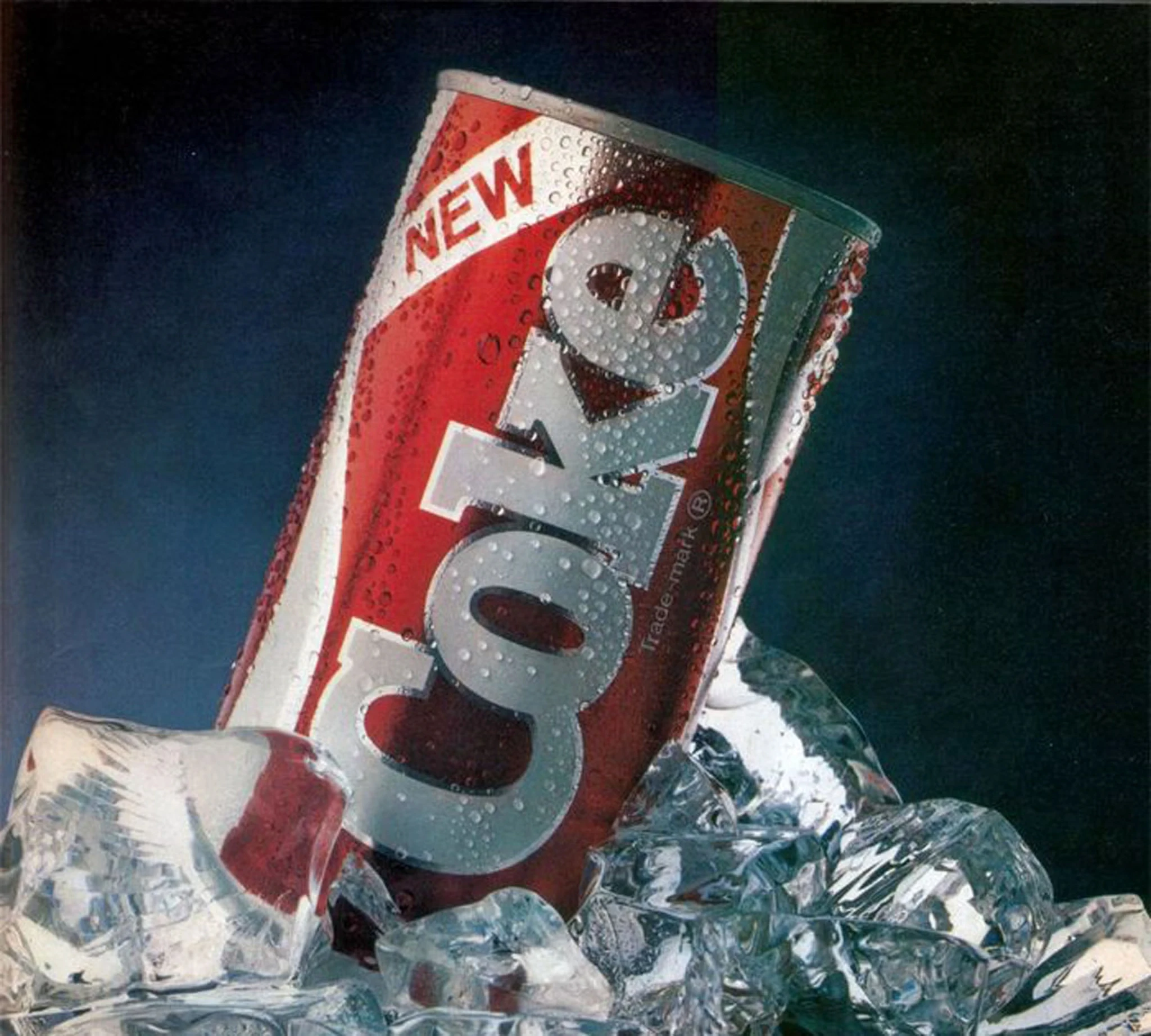
In April 1985, Coca-Cola replaced the formula at the centre of its business.
The decision did not come from boredom in the design department. Pepsi was gaining ground, blind taste tests favoured a sweeter profile and Coca-Cola had evidence that consumers preferred the new formula in controlled research.
The logic looked sound inside the test.
Then the test met the brand.
Customers did not experience Coca-Cola as a liquid sample with the label removed. They experienced it as memory, habit, identity and ritual. It belonged to family tables, baseball games, vending machines, Christmas advertising and a particular version of American life. Changing the formula did not feel like improving a product. It felt like taking something familiar away.
The research measured taste. The market responded to meaning.
Preference is not the same as attachment
Blind testing can answer a useful question: which sip does someone prefer without context?
It cannot fully answer a different one: what does this product represent when the name, history and possibility of loss return?
Those are not competing forms of truth. They are different conditions.
The sweeter formula could perform well in a sip test while the original Coca-Cola remained more valuable as a complete brand experience. One measured immediate sensory preference. The other contained decades of accumulated attachment.
The mistake was not listening to customers. It was asking too narrow a question and treating the answer as complete.
The strongest brand assets are often invisible internally
Inside a company, familiar elements can begin to look ordinary. The same bottle shape, colour, script, formula and language appear every day. Teams see repetition where customers feel recognition.
That creates a dangerous temptation. If an asset feels old internally, change can look like progress.
But legacy is not clutter simply because it has been present for a long time. Some forms of familiarity reduce doubt, carry memory and make a brand easier to choose. Their value lives outside the organisation, in the minds and routines of customers.
You do not protect them because they are old. You protect them because they are still doing useful work.
Removing something reveals what it carried
The response to New Coke was immediate and emotional. Calls and letters arrived. Loyal customers stockpiled the original product. The decision became national news.
Less than three months after the launch, the company brought the original formula back as Coca-Cola Classic.
The speed of the reversal mattered. Coca-Cola did not defend the decision until the market grew tired of objecting. It acknowledged that the product carried a meaning its research had underestimated.
The episode eventually strengthened public awareness of that attachment, but it would be generous to treat the backlash as the plan.
Sometimes a brand only discovers the weight of an asset after trying to remove it.
Evolution has to know what it is carrying forward
The lesson is not that established brands should never change. Coca-Cola has changed packaging, campaigns, products, channels and cultural expression many times.
The distinction is between evolution and erasure.
Evolution asks which elements hold recognition and trust, then builds new relevance around them. Erasure treats history as an obstacle and assumes customers will transfer their attachment on command.
Good brand work identifies the non-negotiable signal before it begins modernising the surface. It knows which parts can flex, which parts can vary and which parts carry more memory than the organisation can recreate quickly.
Change is not a strategy by itself. It needs a commercial reason and a clear account of what must not be lost.
The lesson
New Coke was not a warning against design. It was a warning against reducing brand choice to the part that can be isolated and measured most easily.
Customers buy products, but they also buy continuity, recognition and the stories they have attached to them. Research has to account for the full experience, especially when a decision removes something people already consider theirs.
Coca-Cola tested the taste. The market reminded it where the value lived.
[
MORE NOTES
]
Continue reading our latest journals

[contact]